Discs are dying. Sony is cutting production by 2028. The dream of owning your library feels distant again.
Retro gaming? Not so much. It’s exploding.
Most folks chase FPGA hardware—exact silicon copies of the past. The Analogue Pocket, the MiSTer, they are expensive and brilliant. Then there is Epilogue. They take a different path. Instead of a mini console, they built a cartridge adapter for your PC.
The SN Operator arrived after the Game Boy model. It connects to your laptop via USB-C. You plug in your original SNES cartridge. You play. It’s that simple.
Big Box. Small Problems.
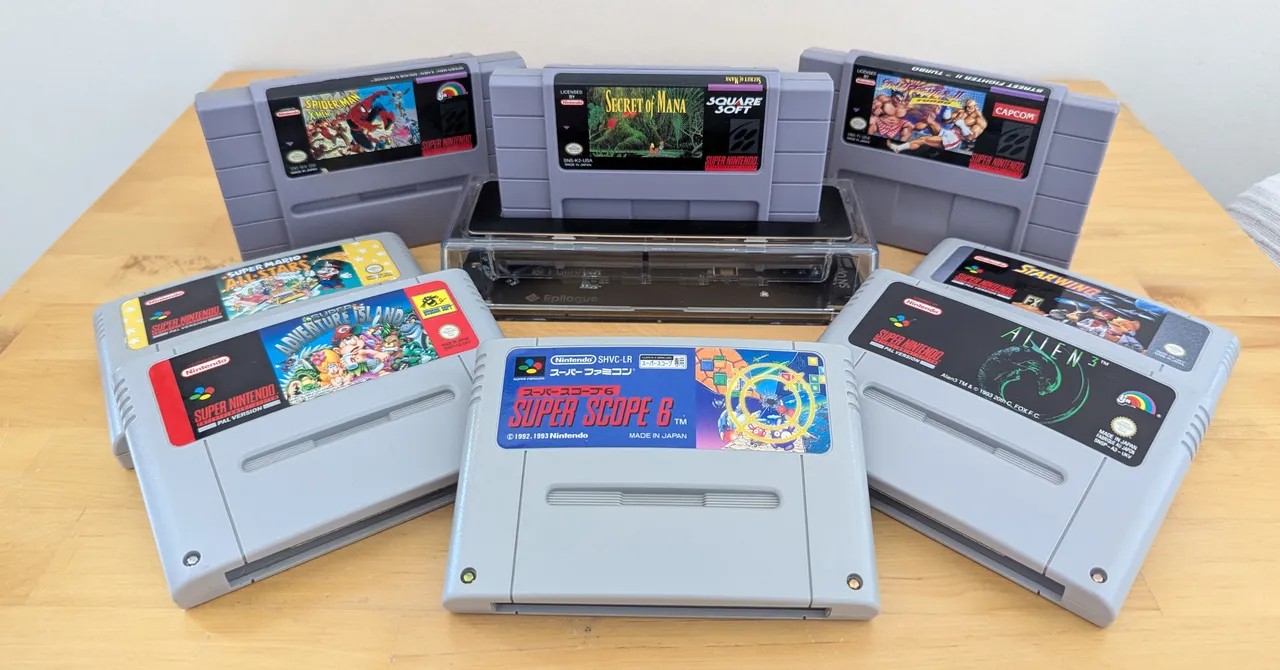
It’s bigger than the Game Boy version. Of course it is. SNES carts are huge. The unit is a block of clear acrylic. 185x70x37 millimeters. Heavy enough to stay put, light enough to carry. 230 grams. It has guard flaps on the slot to keep dust out. A nice touch.
Setup is lazy. Connect to Windows, Mac, or Linux. Run the Playback software. Insert cartridge. Play.
The visuals are flexible. You get pixel-perfect modes. You get CRT shaders that make the screen look curved and warm. There are even filters that mimic the grey scale of a Game Boy. Weird, but there.
Full screen mode is annoying. You stretch the window to fill the monitor, and black bars remain. Thick ones. I looked for a setting to crop the image properly. Pillbox borders only. I found nothing.
You can tweak the emulator cores. BSNES is default. Five versions of Snes9x are included. You can add more if you like digging into config files. Most people won’t. The defaults work fine.
The Region Lock is Dead. Long Live It.
This is the killer feature.
The SNES hated you if you lived outside North America. European and Japanese slots had different shapes. The carts wouldn’t fit. Then you needed adapters to fool the lockout chips. And then there was PAL.
PAL ran at 50Hz. NTSC ran at 60Hz. Your Street Fighter II played at a crawl. It felt sluggish. Spider-Man and the X-Men played like Spidey was swimming in wet cement.
The SN Operator ignores all of it.
Put in a Japanese Super Famicom cart. Put in a European PAL game. Put in an American NTSC cartridge. It loads. The speed is fixed to 60Hz automatically if needed. My UK copy of Star Wing (they couldn’t use the name Star Fox in Europe) plays fast and correct. The software even identifies the region for you.
It handles peripherals too.
Use a modern mouse for Mario Paint or Populous II. It works. Use a mouse as the Super Scope light gun. It works too. It makes those niche shooters absurdly easy to hit with. A mouse has precision. A CRT light gun did not.
Save states exist now. The first operator did not support them well. Here? You can snap a save anytime. I played through Secret of Mana. A massive JRPG. I didn’t have to wait for a bed. I just paused. Saved. Left.
Price. And The Catch.
The hardware costs $60. That’s cheap.
The games? Not so cheap.
Do you want Chrono Trigger? The English version costs hundreds on the secondary market. This isn’t Epilogue’s fault. Collectors drive up the prices. It’s a barrier to entry. You can’t just buy these games new anymore.
Some suggest importing cheap Japanese carts. A JP Chrono Trigger might be $20. Smart idea?
There’s a catch. No translation patches.
Epilogue told me they are looking into it. Maybe later. But right now? You insert the Japanese cart, and you play in Japanese. Or you buy the expensive English version.
They are working on online multiplayer too. Maybe Satellaview support someday. That would be wild.
Is it perfect? No. The full screen cropping is a bug that needs fixing. Translation patches are missing.
But for $60, it lets you play any SNES game from any country. At the correct speed. With save states. On your monitor.
It’s close enough. Until they fix the text translation, I guess we’re reading subtitles in our heads. 🎮