
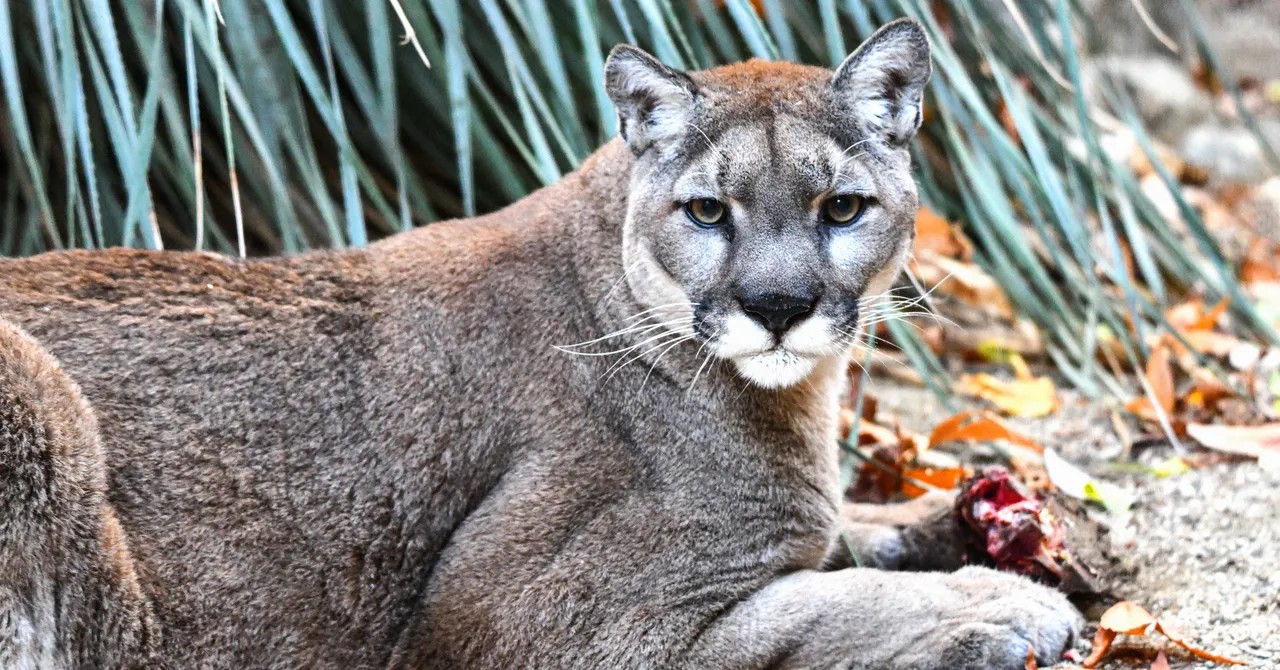
Bring in the big cats.
If your driving anxiety stems from the sudden appearance of a deer in low light, consider that the solution might already be prowling in the woods.
A study published in Current Biology reveals a stark reality: areas with healthy cougar populations see auto accidents involving deer drop by as much as 76%.
This isn’t about hunting the cats for safety. It is about letting apex predators do what they do best.
When cougars—also known as mountain lions, panthers, and pumas—roam near roads that slice through forests or edge up against developments, deer get the memo. They avoid these areas. Fewer deer on the roadside means fewer collisions.
It is a simple ecological lever. Pull it right, and traffic safety improves.
The Predator Gap
Cougars are native to the Americas.
Their range collapsed after European colonization due to hunting and habitat loss. Today, you mostly find them in the western United States and a small corner of Florida.
Deer, meanwhile, have thrived.
Without their primary predators, and with forests cleared for agriculture, their numbers exploded over the last century. They are everywhere. They are bold. And they love grazing on the verges of our highways.
The cost of this imbalance is measured in insurance claims and lives lost. State Farm recorded 1.8 million animal-related auto insurance claims between 2022 and -2023. Deer were the top culprit.
The Insurance Institute for Highway Safety notes that deadly collisions with animals have risen steadily since the 1970. Last year, over 200 people died.
“Deer are a hazard in part because there areso many of them and in partbecause they frequently forage onthe side of roadways.”
We built roads through their habitat. They followed us. Now they get run over.
The Olympic Peninsula Experiment
To understand how cougars change this dynamic, researchers looked at data from the Olympic Peninsula in Washington State.
Panthera, a wildlife nonprofit, has monitored cougars there since 2018. The study built on decades of work by tribal biologists.
Justin Suraci, a senior scientist at Conservation Science Partners and lead author of the study, notes that while the costs of living with predators—like cattle losses for ranchers—are well documented, the benefits are not.
The team wanted to quantify the “costs and benefits” of coexistence.
Specifically, they looked at behavior.
How Cougars Act as Traffic Cops
The methodology was precise.
Researchers compared data from over 500 camera traps against a year of car accident reports involving deer.
Cougars are ambush predators.
They thrive in “edge” habitats. These are the zones where roads cut through dense forest or where low-density housing pushes against the tree line. These spots offer cover for the cat and easy targets for deer foraging at the perimeter.
The deer, sensing this risk, adapt.
Suraci explains that deer move away from these habitat edges. They retreat deeper into the woods. By doing so, they avoid the roads and development where traffic—and vehicle collisions—are highest.
It is a behavioral shift driven by fear. A useful fear.
The results were quantifiable.
- Deer were 15% more likely to avoid areas where cougars hunted.
- They were 86% more likely to spend time in heavily wooded areas.
- They shifted activity to daytime, avoiding the twilight hours when both drivers and deer are most vulnerable.
Over a five-year span, collision rates dropped more than 76% compared to areas with few cougars.
Ruling Out Population Decline
You might ask: Does the crash reduction happen because cougars eat more deer?
No.
Prior studies on carnivores and traffic safety helped the team design this check. Earlier research on wolf reintroduction in Wisconsin and modeled cougar expansion provided a baseline.
These historical data points allowed researchers to separate behavioral avoidance from population decline. If fewer deer meant fewer crashes, that would be a different story. But the data showed the deer were still there in the woods. They just weren’t on the shoulders of the roads.
This confirms that the mechanism is avoidance, not predation pressure reducing the total deer count.
What This Means for Drivers
The presence of a predator changes the landscape.
It reshapes where prey moves. It creates invisible barriers that protect human infrastructure.
Does this mean we should reintroduce cougars to every suburb? Probably not.
But it does highlight a specific long-tail query that urban planners and wildlife managers might overlook: How does predator presence affect vehicle-deer collision rates?
The answer is not zero. It is a significant reduction.
The study suggests that maintaining robust predator populations isn’t just a conservation win. It is a public safety feature.
We spend billions on signage, fencing, and animal detection systems. The data implies that a healthy, functioning ecosystem does half the work for free.
The question isn’t really about fear. It is about whether we value the silence of the deep woods over the sound of brakes screeching on a foggy highway.
The cougars know the answer. The deer know it too.
Most drivers just don’t want to think about it.